Executive Summary:
Industry,
Innovation, and Infrastructure in Saudi Arabia
Sustainable Development Goal 9 (SDG 9) focuses on
building resilient infrastructure, promoting inclusive and sustainable
industrialization, and fostering innovation. In Saudi Arabia, SDG 9 is a cornerstone
of Vision 2030, with significant investments in industrial development,
infrastructure modernization, and innovation ecosystems aimed at transforming
the country into a global hub for technology and innovation.
Efforts
by the Saudi Government to Achieve SDG 9
1. Infrastructure Development:
- Mega-projects like
NEOM, The Red Sea Project, and Qiddiya showcase Saudi Arabia’s commitment to
developing world-class infrastructure that integrates sustainability and
technology.
- Investments in
transportation infrastructure, such as high-speed rail systems (e.g., Haramain
High-Speed Railway) and modernized airports, enhance connectivity and
efficiency.
2. Industrial Growth:
- The National Industrial
Development and Logistics Program (NIDLP) aims to diversify the economy by
fostering growth in key industries, including mining, manufacturing, and
logistics.
- The government is
establishing industrial cities and economic zones, such as the King Abdullah
Economic City (KAEC), to attract investment and create jobs.
3. Promoting Innovation:
- The Saudi Authority for
Data and Artificial Intelligence (SDAIA) and the King Abdulaziz City for
Science and Technology (KACST) drive technological research and innovation.
- Saudi Arabia is
fostering an innovation-driven economy by supporting startups and
entrepreneurship through initiatives like Monsha’at and the Public Investment
Fund (PIF).
4. Digital Transformation:
- The Kingdom is heavily
investing in digital infrastructure, including the rollout of 5G technology,
smart cities, and e-government platforms.
- Programs like Saudi
Digital Academy train youth in advanced technology fields, preparing them for
the digital economy.
5. Sustainable Industrial Practices:
- The government
emphasizes green manufacturing and renewable energy production, aligning
industrial growth with environmental sustainability.
- Projects such as the
Saudi Green Initiative integrate sustainable practices into industrialization
efforts.
6. Supporting Research and Development (R&D):
- Saudi Arabia is
increasing its R&D spending to support technological advancements,
innovation, and scientific research.
- Partnerships with
global universities and research institutions enhance knowledge-sharing and
capacity building.
Industry,
Innovation, and Infrastructure in Imam Mohammad Ibn Saud Islamic
University (IMSIU)
1. Innovation and Entrepreneurship
Imam
Mohammad Ibn Saud Islamic University has established the Center for Innovation
and Entrepreneurship as a key hub to foster creativity, innovation, and
entrepreneurial spirit among students and faculty. The deanship provides fully
equipped business incubators, training programs, advisory services, and
co-working spaces to support the development of startups.
Examples of supported initiatives include smart
applications for water and energy conservation, sustainable agriculture
projects, and waste recycling enterprises.
https://units.imamu.edu.sa/deanships/gce/Pages/default.aspx
2. Research
Infrastructure
The university continues to invest in advanced research
infrastructure, including laboratories and centers dedicated to artificial
intelligence, computing, renewable energy, and environmental sciences.
Additionally, IMSIU offers a comprehensive digital
library system and access to global research databases (Scopus, Web of
Science), strengthening academic productivity and innovation capacity.
https://units.imamu.edu.sa/deanships/it/Pages/default.aspx
https://units.imamu.edu.sa/deanships/CENTRAL_LIBRARY/announcements/Pages/Databases.aspx
3. Industrial Partnerships
The university has signed strategic agreements with
national and industrial entities, including the Ministry of Industry and
Mineral Resources, the Saudi Authority for Intellectual Property, and SABIC, to
promote applied research and innovation.
One notable partnership is with Tarshid (National
Energy Efficiency Services Company) to retrofit university facilities, reducing
electricity consumption by up to 41% through energy-efficient lighting and
upgraded cooling systems.
https://tarshid.com.sa/ar/media-center/project-studies/retrofitting_the_campus_buildings_of_imam_mohammad_ibn_saud_islamic_university_in_riyadh
4. Digital Transformation and Artificial
Intelligence
Aligned with Vision 2030, IMSIU has embarked on a
digital transformation strategy, modernizing its academic and administrative
services with smart technologies.
The Deanship of E-Learning and Distance Education plays
a central role in deploying AI-based solutions that enhance teaching, learning,
and service delivery, preparing students for the digital economy.
https://units.imamu.edu.sa/deanships/SR/announcements/Pages/19-5-2025.aspx
https://x.com/IMSIU_edu_sa/status/1960390595207213488
5. Funding Applied Research
The university allocates competitive research grants to
support applied research in strategic areas such as renewable energy,
cybersecurity, smart transportation, and sustainable infrastructure. These
grants encourage faculty members and students to translate innovative ideas
into practical, market-driven solutions.
https://units.imamu.edu.sa/deanships/SR/rs/fp/Pages/default.aspx
6. Sustainable Infrastructure Initiatives
IMSIU is committed to building a sustainable campus by
implementing energy and water efficiency measures.
Key initiatives include:
- Transition
to LED lighting systems across facilities.
- Modernization
of cooling and HVAC systems.
- Water
treatment and reuse programs to optimize resources.
These projects contribute significantly to reducing
operational costs, extending equipment lifespan, and lowering carbon emissions.
7. Scientific Conferences and Exhibitions
The university regularly organizes conferences,
exhibitions, and hackathons to promote innovation and collaboration with
industry.
A notable example is the Health Innovation Hackathon,
which engaged students in developing healthcare-related technological solutions
and showcased their projects to external stakeholders.
https://x.com/IMSIU_edu_sa/status/1835350040962871793?lang=ar
https://imamu.edu.sa/news/Pages/news_21_1_2024_01.aspx
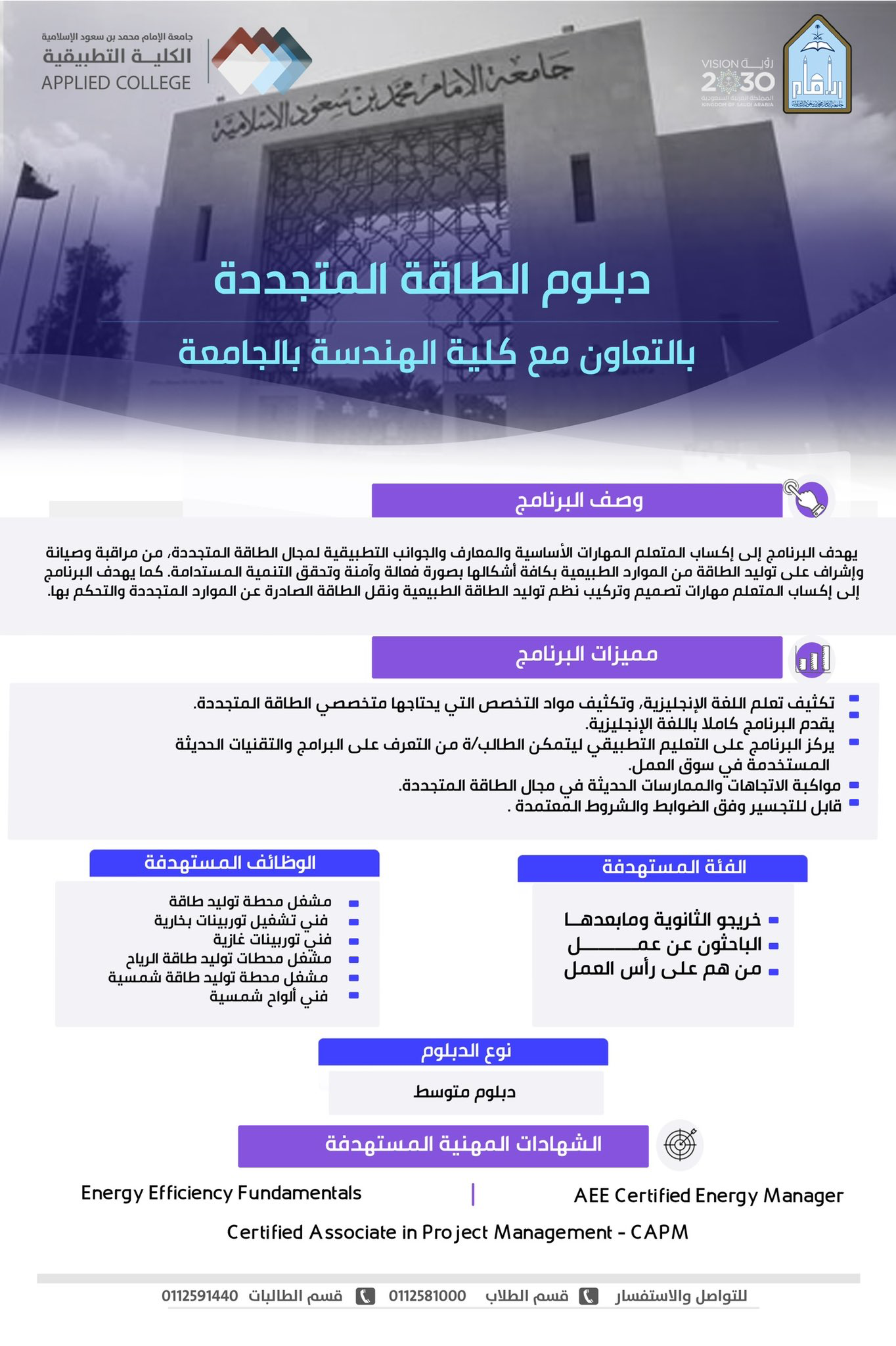
8. Capacity Building Programs
To develop human capital aligned with Vision 2030,
IMSIU offers specialized training programs and diplomas such as the Renewable
Energy Diploma.
These programs prepare national talents with the
technical expertise needed to support the Kingdom’s transition toward
sustainable industries and green infrastructure.
https://x.com/IMAM_U1/status/1821199630161567900
Impact of
IMSIU’s Contributions to Industry, Innovation, and Infrastructure
By fostering innovation, building modern
infrastructure, and supporting sustainable industrialization, IMSIU aligns its
initiatives with national and global goals under SDG 9. The university equips
its students with the skills and knowledge needed to contribute to Saudi
Arabia’s transformation into a knowledge-based and industrialized economy.
Through research, education, and partnerships, IMSIU plays a pivotal role in
supporting the Kingdom's progress toward a resilient and innovative future.
To
promote excellence and innovation in education, scientific research and
management. Al-Imam Muhammad bin Saud Islamic University celebrates its
distinguished employees. Next Sunday
https://imamu.edu.sa/news/Pages/news_10_10_2024_01.aspx
Under the patronage of
His Excellency the Minister of Education, Mr. Yousef bin Abdullah Al-Benyan,
Al-Imam Muhammad bin Saud Islamic University, represented by the University's
Vice Presidency for Institutional Development and Social Responsibility,
organizes the ceremony of the Imam Muhammad bin Saud Islamic University Award
for Excellence in its second session to celebrate the distinguished and
distinguished employees and academic and administrative units.
This award comes with
the aim of promoting a culture of excellence and innovation in the fields of
education, research and institutional and administrative excellence, and it is
part of the university's strategies aimed at honoring distinguished individuals
and units, which contributes to improving the quality of the educational and
research process and reflects the university's vision in supporting and
developing administrative performance.
The Vice President for
Institutional Development and Social Responsibility, Dr. Kholoud bint Fawaz
Al-Tamimi, explained that the "Excellence Award in its second
session" reflects the university's continuous commitment to excellence and
promoting the spirit of innovation in all academic and administrative fields.
Dr. Al-Tamimi said:
"The successes achieved by the award in its first session contributed to
strengthening the university's position as a leading scientific beacon,
confirming the university's continued excellence by celebrating the winners of
the second cycle.
It is noteworthy that
the award is subject to strict criteria and specific conditions, under the
supervision and follow-up of His Excellency the President of the University, to
honor the exceptional efforts and achievements that contribute to achieving the
sustainable development goals and the university's future vision.
The award includes five
categories: the education branch, which is subject to several main criteria,
most notably teaching performance that focuses on innovation in designing study
plans according to the latest education theories, promoting effective teaching
strategies that support learner centrality, and enriching educational content
by developing it using inductive and deductive methods.
The award also includes
six categories in the research excellence category, including: the Abundance
and Quality of Research Production Award, the Best Author and Translator Book
Award, the Research Excellence Award for Graduate Students, and the Elite
Journals Publishing Award.
In addition, the award
includes the Institutional Excellence category, which is divided into two
categories: educational units and administrative units. An organizational
manual, a job description manual and a policy and procedures manual are
required to apply. The unit must also be part of the organizational structure
of the university, and must have been established for a full year, and these
units are evaluated according to criteria including leadership and management,
management of operations and services, results of employees and beneficiaries,
and business results.
The categories of the
Administrative Excellence Award also include three main areas, including
supervisory leaders, second-line leaders, and support services staff, as the
award targets the university's administrative employees with certain conditions
related to academic achievement, practical experience and commitment to work
ethics. Evaluation and differentiation criteria focus on performance and
achievement, initiative and professional development, collaboration and job
commitment, and leadership skills.
These awards are in
recognition of exceptional achievements and innovative initiatives that
contribute to the achievement of the Sustainable Development Goals, fostering a
stimulating educational and research environment that encourages creativity and
excellence.
Imam Mohammad Ibn Saud Islamic
University Wins Gold and Multiple International Awards at the 49th Geneva
International Exhibition of Inventions
https://units.imamu.edu.sa/deanships/gce/news/Pages/17-4-2024.aspx
Imam Mohammad Ibn Saud Islamic University concluded its
participation this week in the 49th Geneva International Exhibition of
Inventions, held in Geneva, Switzerland, under the patronage of the Swiss
government, the Republic and Canton of Geneva, the City of Geneva, and the
World Intellectual Property Organization (WIPO), during the period 17–21 April
2024, by winning a number of prestigious international awards.
The Geneva International Exhibition of Inventions is
one of the most important and largest global gatherings dedicated to showcasing
inventions from around the world. It serves as an open platform for thousands
of innovations and inventions across diverse fields, including engineering,
environmental protection, energy, and various scientific and industrial
disciplines.
Dr. Sousan bint Abdulkarim Al-Mu’min, Head of the
Center for Innovation and Entrepreneurship and supervisor of the university’s
participation, explained that the university’s involvement came within a
pavilion representing Saudi universities. The aim was to strengthen the
Kingdom’s soft power by showcasing Saudi universities’ latest inventions on the
international stage, competing globally, achieving advanced rankings,
exchanging expertise, exploring international inventions, and engaging with
stakeholders interested in commercializing innovative products.
Dr. Al-Mu’min added that the university participated
with a number of inventions from its affiliates, including those from the
College of Medicine, the College of Engineering, and the Center for Innovation
and Entrepreneurship.
- The
College of Medicine presented the invention “AutiScan”, a device designed
to detect autism spectrum disorder in children by examining the eye
through virtual reality technology and an integrated retinal camera. This
project was developed by Dr. Sarah Al-Muzyadi and students Oroub
Al-Rumaih, Reem Bin Shalhoub, Renad Al-Duhaim, and Lujain Al-Mutairi.
- The
College of Engineering showcased an invention of a “Developed Pen for
Measuring Blood Glucose Levels”, consisting of three integrated components,
by student Ahmed Al-Roqi.
- Participants
from the Mubtaker Program at the Center for Innovation and
Entrepreneurship presented two projects:
- “Yaqeen
Mattress”, a smart mattress, by Sa’eeda Al-Maliki.
- “Smart
Chemical Regulation of Temperature (SCRT)”, an innovative medical
technology designed to proactively reduce children’s body temperature
during sleep, by Doulah Al-Sulaiman.
All of these inventions were awarded gold and bronze
medals, reflecting the high quality of the university’s innovations.
Dr. Al-Mu’min emphasized that the university’s
participation in the Geneva International Exhibition aligns with the strategic
objectives of Imam Mohammad Ibn Saud Islamic University’s 2025 Strategic Plan,
derived from Saudi Vision 2030, through fostering innovation among faculty and
students, contributing to the achievement of the UN Sustainable Development
Goals, strengthening international engagement, and establishing impactful
global presence.
Dr. Khalid bin Abdullah Al-Muhanna, Supervisor of the
Intellectual Property and Technology Transfer Office at the Center for
Innovation and Entrepreneurship and a member of the university’s delegation,
praised the exhibited innovations. He highlighted the comprehensive support
provided by the Center for Innovation and Entrepreneurship to all participants,
including preparation, training, and facilitation of their projects.
The participants also expressed pride in their
achievements. Student Ahmed Al-Roqi noted that his participation was a major
milestone in his academic journey, offering opportunities to meet investors and
gain international exposure. Innovator Sa’eeda Al-Maliki expressed her honor to
represent the university, noting that such participation allows direct contact
with industries, enhances knowledge of modern technologies, and creates avenues
for future collaborations. Both extended their gratitude to the university and
the Center for Innovation and Entrepreneurship for their unwavering support.
Dr. Sousan Al-Mu’min extended her heartfelt thanks to
H.E. Minister of Education Mr. Yousef bin Abdullah Al-Benyan for the Ministry’s
ongoing support in fostering innovation within Saudi universities. She also
expressed deep appreciation to H.E. University President Prof. Ahmed bin Salem
Al-Amri for his unlimited encouragement, as well as to Prof. Abdullah bin
Abdulaziz Al-Tamim, Vice President for Graduate Studies and Scientific
Research, for his continuous support. Special thanks were also given to Dr.
Abdulrahman bin Mohammed Al-Kharashi, Dean of Student Affairs, for the Student
Fund’s sponsorship of student participants, Dr. Hassan bin Ali Al-Shehri, Dean
of the College of Medicine, and Dr. Nashmi bin Hassan Al-Rashidi, Dean of the
College of Engineering, for supporting their respective colleges’ innovators.
The university’s pavilion was honored by visits from
several distinguished figures, including H.E. Dr. Mohammed bin Ahmed
Al-Sudairi, Vice Minister of Education, H.E. Dr. Abdulmonim Abdul-Salam
Al-Hayani, Deputy Minister for University Education, and Ambassador Abdulmohsen
bin Majid bin Khuthaila, Permanent Representative of the Kingdom of Saudi
Arabia to the United Nations in Geneva, along with other notable dignitaries.
They were warmly received by Dr. Sousan Al-Mu’min and Dr. Khalid Al-Muhanna.
This outstanding achievement reflects Imam Mohammad Ibn
Saud Islamic University’s firm commitment to innovation, entrepreneurship, and
international engagement, strengthening its role as a leading institution in
driving sustainable development and contributing to Saudi Vision 2030.
Stanford Innovation Leadership Seminar at IMSIU
https://imamu.edu.sa/news/Pages/news-21-3-1442-00.aspx
Imam Mohammad Ibn Saud Islamic University, in
collaboration with Stanford University (USA), organized the “Stanford
Innovation Leadership Seminar: Leading Change and Building a Culture of
Innovation” on October 27, 2020, under the patronage of H.E. Prof. Ahmed
bin Salem Al-Amri, University President. The virtual seminar highlighted the
role of leadership, design thinking, and organizational culture in driving
innovation and sustainable development. Stanford experts, including Prof.
Robert Sutton, Prof. William Burnett, and Mr. Tim Wasserman, shared insights on
leading change and fostering creativity, with active participation from
university leaders and faculty members.